

Europe offers countless historic cities, but some destinations make it possible to experience imposing fortresses and remarkable churches within the same compact trip. Medieval strongholds, royal palaces, Gothic cathedrals, and centuries-old abbeys often stand only a short walk apart, revealing how political and religious power once shaped entire cities. For travelers drawn to stone towers, elaborate sanctuaries, and layered history, several destinations offer especially strong combinations of castles and historic churches.
1. Prague, Czech Republic
Prague places one of Europe’s great castle complexes directly above a city filled with historic churches. Founded in the ninth century, Prague Castle developed as the seat of Bohemian rulers and today includes the Old Royal Palace, St. George’s Basilica, Golden Lane, and several courtyards. St. Vitus Cathedral rises from within the complex itself, allowing visitors to experience royal and religious history without even leaving the castle grounds.
The cathedral was founded in 1344 and took nearly six centuries to complete. Its interior includes St. Wenceslas Chapel, royal tombs, and the chamber associated with the Czech Crown Jewels. Beyond the castle hill, Prague adds churches such as the Church of Our Lady before Týn and St. Nicholas Church, making the city especially rewarding for travelers interested in Gothic, Romanesque, and Baroque architecture.
2. Kraków, Poland
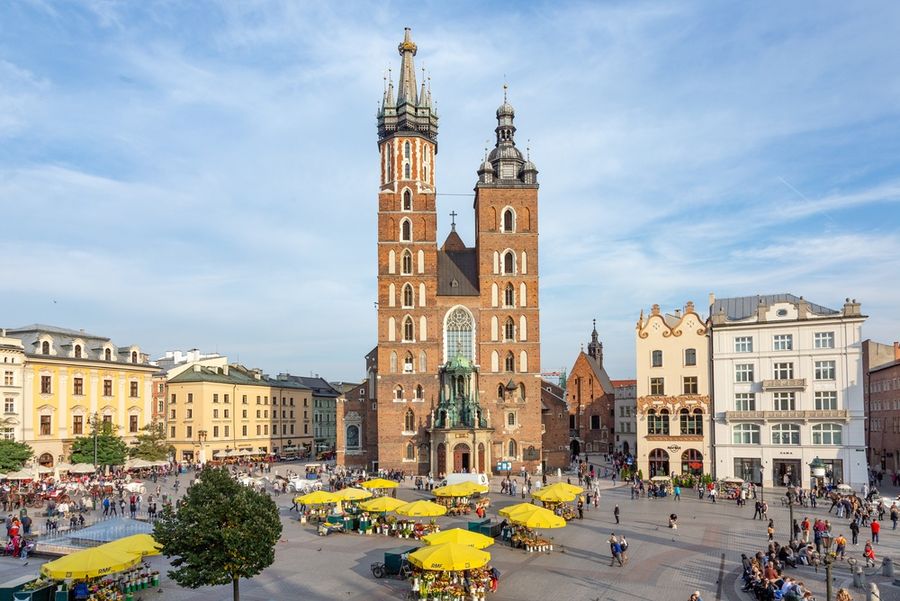
Kraków’s Wawel Hill brings its royal castle and cathedral together in one of Poland’s most historically significant settings. Wawel Royal Castle contains Renaissance royal apartments, ceremonial rooms, courtyards, and collections connected with Poland’s former monarchy. Immediately beside it stands Wawel Cathedral, while the nearby Old Town adds St. Mary’s Basilica and numerous other historic churches.
The compact geography makes Kraków particularly easy to explore on foot. Visitors can begin on Wawel Hill, follow the old Royal Route toward the Main Market Square, and encounter centuries of architecture along the way. The combination of castle, cathedral, medieval streets, city gates, and churches creates a strong sense of continuity rather than a collection of disconnected monuments.
3. Edinburgh, Scotland
Few European cities integrate a fortress into their skyline as dramatically as Edinburgh. Edinburgh Castle occupies the volcanic Castle Rock at the western end of the Royal Mile, while that same historic street leads toward a series of important religious and civic landmarks. St. Giles’ Cathedral sits almost midway along the route and traces its history back roughly 900 years.
Inside St. Giles’, visitors can see stained glass, medieval stonework, and the ornate Thistle Chapel. The city also offers additional historic sites such as Craigmillar Castle, while Rosslyn Chapel lies several miles south of the center. Edinburgh therefore works particularly well for travelers who want castles and churches surrounded by an urban landscape that still feels visibly historic.
4. Salzburg, Austria
Salzburg provides a different combination: an immense hilltop fortress overlooking a city shaped for centuries by powerful prince-archbishops. Construction of Hohensalzburg Fortress began in 1077, and the complex was expanded repeatedly before reaching much of its present appearance around 1500. Today its courtyards, defensive structures, museums, and elevated views make it one of the city’s defining landmarks.
Below the fortress, Salzburg’s historic center contains an unusually dense collection of churches. Salzburg Cathedral dominates the old city with its Baroque dome and twin towers, while St. Peter’s Abbey, the Franciscan Church, Collegiate Church, and Nonnberg Abbey add further layers of ecclesiastical history. The close relationship between religious authority and secular power is visible almost everywhere in the historic center.
5. Toledo, Spain
Toledo is an especially strong choice for travelers interested in religious history because Christian, Muslim, and Jewish traditions all left major architectural landmarks within its medieval center. Toledo Cathedral, begun in 1226, became one of Spain’s major Gothic churches, with stained glass, elaborate chapels, sculpture, and an enormous interior supported by dozens of columns.
The Alcázar occupies another commanding position above the city, continuing a long tradition of fortification on the site. Visitors can walk between the fortress, cathedral, medieval gates, the Monastery of San Juan de los Reyes, historic synagogues, and the Mosque of Cristo de la Luz. Toledo’s tightly packed streets make centuries of changing political and religious control unusually tangible.
Where Fortresses and Faith Share the Same Skyline
Prague and Kraków offer royal complexes where castles and cathedrals sit almost side by side, while Edinburgh connects its fortress and historic church along the Royal Mile. Salzburg surrounds a monumental hilltop stronghold with the architectural legacy of its prince-archbishops, and Toledo layers Christian, Muslim, and Jewish history inside a fortified medieval city.
For travelers who want more than a single famous monument, these destinations offer entire historic environments to explore. Castles provide the political story, churches reveal the religious and artistic one, and the streets between them show how the two were intertwined for centuries.